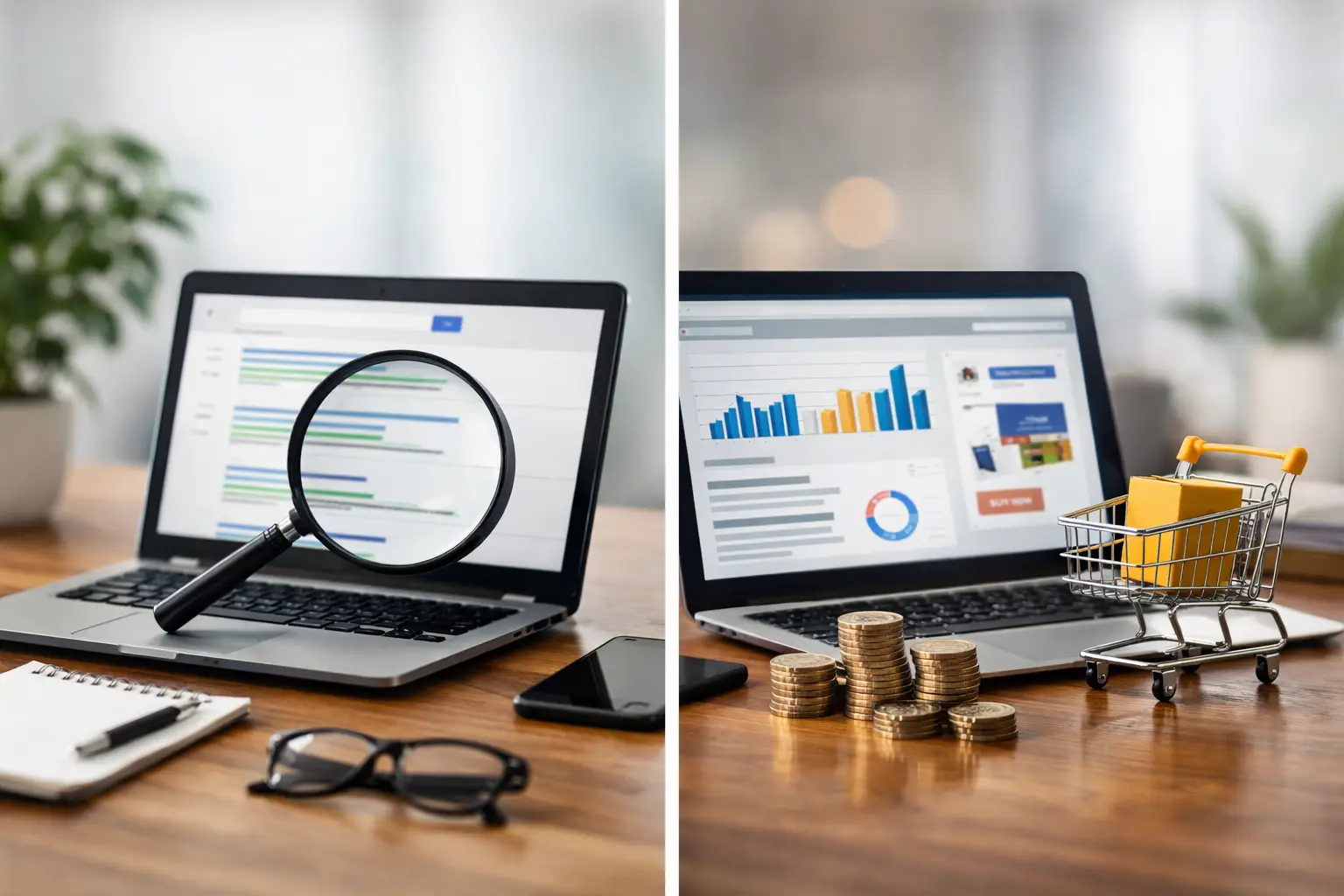
If your phone is not ringing enough or your pipeline feels patchy, the seo vs paid ads question stops being a marketing debate and becomes a business decision. Most SMEs are not choosing between two theories. They are choosing where to put limited budget, how quickly they need leads, and how much risk they can carry while results build.
The short answer is that neither channel is universally better. SEO can build a steady source of qualified traffic over time. Paid ads can put you in front of the right people almost immediately. The right choice depends on your margins, your sales cycle, your website, and how urgently you need enquiries.
SEO vs paid ads: the real difference
SEO is about earning visibility in organic search results. You invest in site performance, technical structure, content, local relevance and authority so that Google sees your site as a strong answer to a user’s query. That takes time, but the payoff can be durable.
Paid ads work differently. You pay to appear in search results, on social platforms, or across display networks. If the campaign is set up well, you can start generating traffic and leads quickly. If you stop spending, visibility usually stops too.
That is the first major trade-off. SEO is slower to build but can keep producing value after the initial work is done. Paid media is faster to activate but depends on ongoing budget.
For many business owners, the mistake is framing this as a winner-takes-all choice. In practice, the best answer is often based on timing. What do you need now, and what do you need six to twelve months from now?
When SEO is the better investment
SEO tends to suit businesses that want sustainable lead generation and are prepared to build properly. If you offer services people actively search for, organic visibility can become one of your strongest commercial assets.
Take a solicitor, accountant, clinic or trades business in a competitive local area. If potential customers are searching regularly for those services, appearing in organic results can drive consistent, high-intent traffic. Those clicks do not carry a direct cost each time someone visits, which can make SEO more cost-efficient over the long term.
It also has a trust factor. Some users skip ads and go straight to organic listings because they see them as more credible. That does not mean paid ads are mistrusted across the board, but strong organic visibility can support authority in a way that is hard to replicate with budget alone.
SEO is also a better fit when your website is central to your growth strategy. If your site is built to perform, loads quickly, works properly on mobile, and makes it easy for people to enquire, then SEO improvements do more than increase traffic. They strengthen the whole lead generation system.
The downside is patience. SEO is not an overnight fix. If your site has technical issues, weak content or poor conversion paths, progress can take months. In competitive sectors, it can take longer. That is why unrealistic expectations cause frustration. SEO works best when treated as a strategic asset, not a panic button.
SEO works well if:
Your customers search for your services regularly, you want lower cost acquisition over time, and you can commit to improving both your website and your visibility consistently.
When paid ads make more sense
Paid ads are often the right move when speed matters. If you are launching a new service, entering a new area, or need leads in the short term, paid search can get you in front of buyers quickly.
For SMEs, that speed can be valuable. You do not need to wait for rankings to improve before you start testing offers, keywords and landing pages. You can see what converts, refine your message and identify which services actually drive profitable enquiries.
Paid ads also give you stronger control. You can target by location, search intent, device, time of day and audience behaviour, depending on the platform. That level of precision helps if your service area is specific or your audience is niche.
There is another practical benefit. Paid campaigns generate data fast. You learn which headlines attract clicks, which pages convert, and which search terms bring serious buyers rather than time-wasters. That insight can improve your wider marketing, including SEO.
The catch is cost. In competitive sectors, cost per click can rise quickly. A campaign that looks busy on paper can still underperform commercially if the targeting is weak, the landing page is poor, or the sales process is slow to follow up. Traffic is not the same as leads, and leads are not the same as revenue.
This is where many businesses get burned. They spend money sending visitors to a website that was never built to convert. If your site is confusing, slow or unclear, paid ads can simply help more people bounce faster.
SEO vs paid ads for lead quality
Lead quality depends less on the channel itself and more on how well the strategy matches intent. Both SEO and paid ads can generate excellent leads. Both can also waste budget.
Organic traffic can be highly qualified when your pages match what people are genuinely searching for. Someone landing on a focused service page after searching for a specific solution is often a strong prospect. But if your SEO strategy targets broad, low-intent traffic, volume may rise without improving outcomes.
Paid ads can bring very qualified leads when campaigns are tightly structured around commercial intent. A search ad triggered by someone looking for your exact service in your area can perform extremely well. But broader campaigns, weak negative keyword management, or vague copy can attract irrelevant clicks.
This is why the real conversation should not just be seo vs paid ads. It should be intent vs waste. The businesses that win are the ones that align messaging, targeting and landing page experience with what the customer actually wants.
Cost, ROI and what SMEs often overlook
A lot of businesses compare SEO and paid media based on upfront spend. That is understandable, but it is incomplete.
With SEO, the investment often goes into technical fixes, content improvements, local optimisation and ongoing work. The return may not be immediate, but once rankings improve, the marginal cost of additional traffic is relatively low.
With paid ads, the spend is more visible because it is tied directly to clicks and campaign management. That can make it easier to measure quickly, but not always more profitable in the long run.
What many SMEs overlook is conversion rate. If your website turns 1 per cent of visitors into leads, both channels become more expensive. If it converts 5 per cent, both channels become more effective. The quality of the website sits underneath the whole decision.
That is why channel choice should never be made in isolation. A poor site can make both SEO and paid ads look weaker than they really are. A high-performing site gives both a better chance of delivering a strong return.
The strongest approach is often both
For growth-minded businesses, the smartest model is often to use paid ads for immediate visibility while building SEO for long-term stability. One gives you speed. The other gives you resilience.
Paid campaigns can generate leads while your organic presence develops. At the same time, SEO can reduce your dependence on ad spend over time. You are not relying on one tap that turns off the moment budget tightens.
Used properly, the two channels also support each other. Paid search data can show which keywords convert. SEO can strengthen brand visibility so your ads perform better. Better website performance helps both channels produce more from the same traffic.
This joined-up thinking is where many agencies fall short. They treat channels separately when the real opportunity is in how they work together. Smarter Sites takes the opposite view: no jargon, no nonsense, just digital activity built to perform against real business goals.
How to decide what is right for your business
Start with three questions. How quickly do you need leads? How competitive is your market? Is your website currently capable of converting traffic into enquiries?
If you need results this month, paid ads are usually the faster route. If you are planning for sustained growth and your services have strong search demand, SEO deserves serious investment. If your website is underperforming, fix that before scaling either channel too far.
There is also a budget reality. A modest budget can still work in paid media if the targeting is tight and the offer is strong, but some sectors are simply expensive. Equally, SEO on a weak site with no clear strategy can become a slow, frustrating spend with little to show for it.
The better decision is rarely based on channel preference. It is based on commercial fit. What is likely to bring qualified leads at a sensible cost, given your market, your margins and your current digital setup?
If you are weighing up seo vs paid ads, do not ask which one is better in general. Ask which one solves your next business problem, and whether your website is ready to turn that traffic into something valuable. That is where the real return starts.