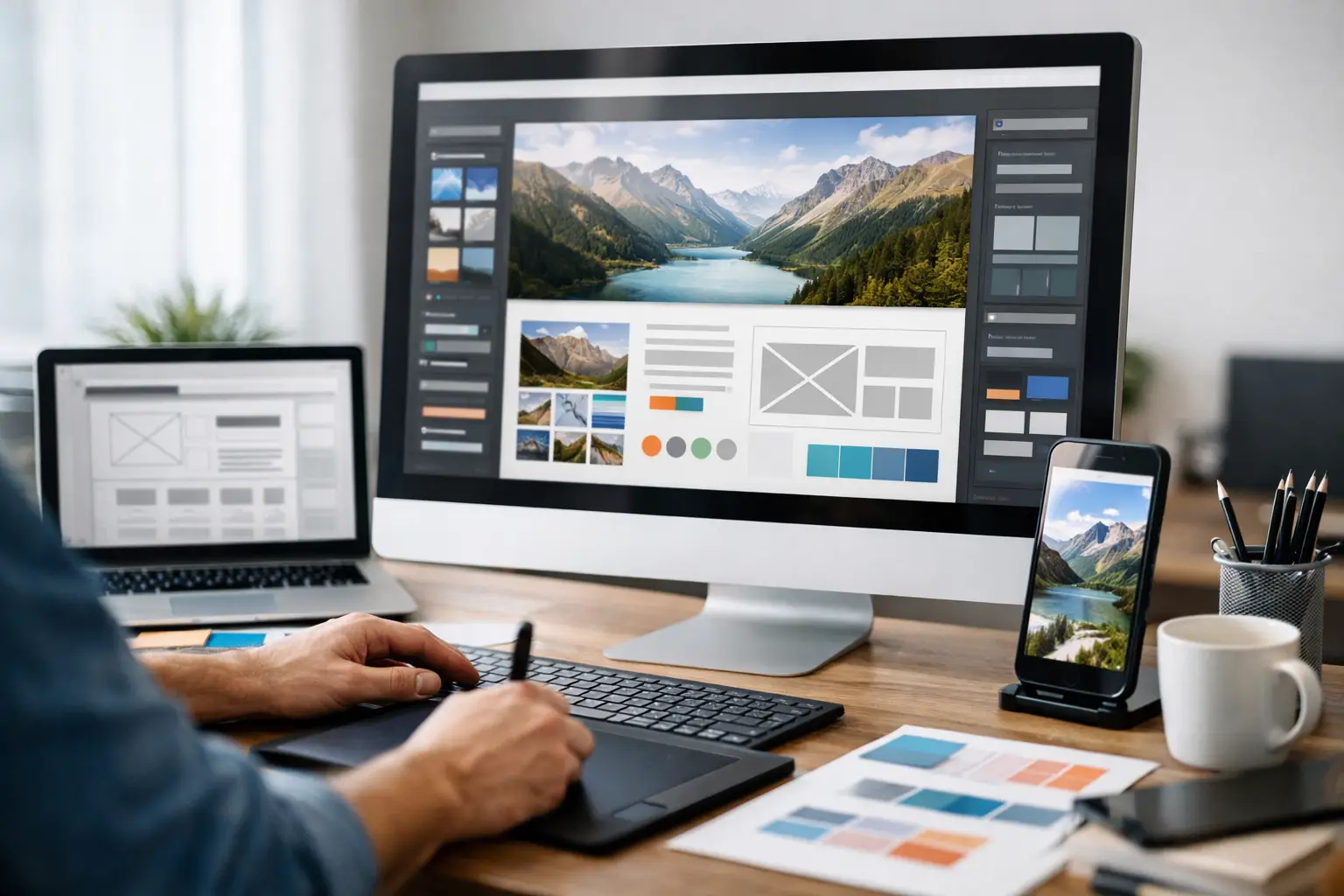
A website can look polished and still quietly cost your business enquiries every week. Slow pages, weak messaging, clumsy mobile layouts and confusing calls to action all chip away at trust. That is why professional web design is not really about making a site look modern. It is about building something that helps people choose you.
For most SMEs, your website is doing several jobs at once. It needs to explain what you do, prove you are credible, answer objections, guide people towards action and work properly on every device. If even one of those jobs is handled badly, performance drops. You may still get traffic, but fewer leads come through and more prospects leave before making contact.
What professional web design actually means
Professional web design is often misunderstood as a visual service. Branding, layout and imagery matter, of course, but design on its own is not the finish line. A business website should be planned around user behaviour and commercial goals.
That means structure comes before decoration. What does a visitor need to know first? What is stopping them from enquiring? Which pages matter most? How quickly can they understand your offer? A well-designed site answers those questions clearly, without forcing users to hunt for basic information.
There is also a technical side that many businesses only notice when something goes wrong. If pages are slow, forms fail, mobile menus are awkward or content is hard to update, the site becomes a burden. Good design includes performance, usability and maintainability. It should work hard for your business, not create extra admin.
Why professional web design affects leads and sales
People make fast judgements online. Within seconds, they decide whether your business feels credible, relevant and easy to deal with. Those judgements are shaped by design, but not in the way many assume.
A clean layout helps, but what really moves the needle is clarity. If your headline is vague, your navigation is cluttered or your service pages read like internal notes, visitors hesitate. Hesitation kills conversions. The same applies if your contact options are buried or your site gives no reason to trust you.
Professional web design improves lead generation because it reduces friction. It helps users find the right information quickly, understand the value of your service and take the next step without uncertainty. In practical terms, that can mean more quote requests, more phone calls and better quality enquiries.
It also supports the rest of your marketing. Paid ads, organic search, email campaigns and social traffic all become more effective when the landing experience is strong. If the website underperforms, every channel feeding into it becomes less efficient.
The difference between a nice-looking site and a high-performing one
This is where many businesses get caught out. A site can win approval in a design presentation and still fail in the real world.
A nice-looking site tends to focus on surface-level appeal. It may use large imagery, fashionable animations and minimal text, but struggle to explain what the business actually offers. It often looks best on a desktop screen and falls apart once real users start browsing on mobile.
A high-performing site is less interested in showing off. It is designed around outcomes. It makes the offer clear, gives each page a job, uses content strategically and removes barriers to action. It still looks professional, but every design choice supports a commercial purpose.
There is a trade-off here. Heavier visual effects can create impact, but they can also slow the site down and distract from the message. Minimal layouts can feel modern, but if they remove too much context, users may leave with unanswered questions. The right balance depends on your audience, your service and how people buy from you.
What to expect from professional web design
If you are investing properly, the process should be more consultative than cosmetic. A good agency or web partner should ask about your business model, lead sources, sales process and ideal customers before talking too much about fonts or colour palettes.
That discovery work matters because different businesses need different website structures. A local trades firm may need fast trust signals, clear service area information and simple quote forms. A healthcare provider may need stronger reassurance, careful content hierarchy and easier access to booking information. A B2B consultancy may need more authority-building content and longer-form service pages.
Professional web design should usually include clear messaging, user-focused page layouts, mobile responsiveness, sound technical foundations and a practical content management setup. It should also account for search visibility, conversion points and future growth. If your business adds services or campaigns later, the site should support that without needing to be rebuilt from scratch.
Why mobile performance matters more than ever
For many SMEs, most website visits now come from mobile devices. Yet mobile design is still often treated as a secondary check at the end of a project.
That approach is costly. Mobile users are typically less patient, more distracted and more likely to abandon a site if anything feels awkward. Buttons that are too small, forms that are tedious, text that is hard to scan or pop-ups that cover the screen all create unnecessary drop-off.
Professional web design should account for mobile use from the start. That does not just mean shrinking a desktop layout. It means prioritising the most important information, simplifying interactions and making contact options easy to use with one hand on a smaller screen.
If your business relies on calls, bookings or fast enquiries, mobile usability can have a direct impact on revenue. It is not a finishing touch. It is core functionality.
Content and design need to work together
One of the most common problems on business websites is the split between visuals and messaging. Design is treated as one project, copy as another, and the final result feels disjointed.
In reality, good web design depends on good content. Headings, page structure, service explanations, proof points and calls to action all shape how users move through the site. If the words are weak, the design has to work much harder.
The best results usually come when design and content are developed together. That way, layouts support the message rather than fight it. Important selling points can be given proper space. Calls to action can appear where users naturally need them. Objections can be answered before they become reasons to leave.
This is especially important for service-led businesses. People are not just buying a product. They are assessing expertise, reliability and fit. Your website needs to communicate those things clearly and calmly.
How to judge whether your current site needs help
You do not always need a full rebuild. Sometimes a site has decent foundations but weak conversion points or outdated content. Other times, the underlying structure is so limited that patching it only delays the problem.
A few signs usually point to a bigger issue. Your site may look dated, but more importantly, it may be hard to update, slow to load, poor on mobile or unclear about what you actually offer. You may be getting traffic without enquiries, or attracting the wrong type of lead. Those are performance problems, not just design preferences.
It is also worth looking at how confidently you send people to your website. If you hesitate before sharing the link, or feel the need to explain what visitors should ignore, that is often a sign the site is not doing its job.
Choosing the right web design partner
Not every business needs the same level of complexity, and not every agency is built for commercial performance. Some are heavily design-led. Others are more technical. The right fit depends on what your business actually needs the website to do.
If leads and sales matter, ask practical questions. How do they approach conversion? How do they think about mobile performance? What happens after launch? Can they explain decisions in plain English? A good partner should be able to talk about outcomes without hiding behind jargon.
This is where a results-focused agency approach tends to stand out. Businesses often do better with a team that sees web design as part of a wider growth picture, not a one-off creative exercise. Smarter Sites, for example, positions web projects around performance, usability and lead generation rather than aesthetics alone. That is usually a healthier model for SMEs that need their site to earn its keep.
Professional web design is an investment, but it should be judged like one. Not by how impressive it looks in isolation, but by whether it helps your business win more of the right work. If your website is going to be a sales tool, treat it like one and expect it to perform.